
Dear fellow investors,
Great investment opportunities are lonely. History shows us the crowd behaviors to avoid and the investment market circumstances to capitalize on. We believe we are at one of the great junctures, where the crowd thinks they unequivocally know the future. Simultaneously, they have left the stocks related to the unknowns for dead. What does history tell us about situations like this? What stocks are mega-cheap based on the unknowns?
History of Sure Things
1972
Disney and Coke were sure things at the end of 1972 in the “Nifty Fifty.” At 80 times and 60 times earnings respectively, their future success seemed like a sure thing. It was lonely to not own them. In 1982, they bottomed at nine- and six-times earnings, even though the future ended up being very bright. Hardly anyone who bought when they were thought to be a sure thing stayed for their success 20 years later.
1981
Peak oil is a repeat sure thing every 10-15 years. It was a sure thing in 1981 at $40 per barrel when energy was 29.5% of the S&P 500 Index. It was dead in 1999 at $11 per barrel and buying was very lonely. It was a sure thing in 2008 and 2014 at $146 and $115 per barrel, respectively. Now it is the deadest it has ever been with energy well less than 3% of the S&P 500 today and oil being given away at settlement recently.
Our favorite measuring tool is to go to investment industry conventions (think Schwab or Morningstar) to see which sponsors were ponying up the most to dominate the center of the floor. In 2011-2014, it was Asia and Peak Oil. Everyone was convinced that nothing could stop China’s new 500 million “middle class” citizens from dominating the world economy for decades. Oil was $115 per barrel in May of 2014 and wide asset allocators sent their clients’ money to die in emerging markets equities under the heading of diversification.
Lastly, the internet would change our life in 1999 and the growth/tech funds hogged up the center of the convention space. The “smart” people avoided the worst of it by buying Cisco, Microsoft and Intel. They were the internet “pickaxe” companies with real sales and earnings. It did limit losses to 60-90% of their portfolio instead of losing 100% on failed dot-com stocks or 95% on Sun Micro, Lucent and many others. There are business cycles in tech!
Source: Cypress Capital, “The Benjamin Button Bull Market”
Now the coronavirus has come along to convince investors big and small that the largest tech companies are a sure thing and that the average person is best able to participate in it via the S&P 500 Index. Tech is a sure thing because we had nowhere else to turn during the government-dictated quarantine and shutdown. The S&P 500 is a “cross-section of America,” or so says Warren Buffett. The composition of the S&P 500 Index is approaching 40% in just the tech sector, Amazon, Facebook and Alphabet combined. Looks very much like late 1999 and not a cross-section of America:
What are the knowns today?
- Online shopping went, and is still going, crazy
- People had nothing to do other than watch TV and communicate online in quarantine
- Groceries became a delight
- Human beings are dying from the virus
What are the unknowns?
- Will people gather at stores, theatres, restaurants, etc.?
- Will people go to stadiums for sports or concerts?
- Will we fly and travel?
- Will we trust each other to do business face-to-face?
- Will the virus resurface?
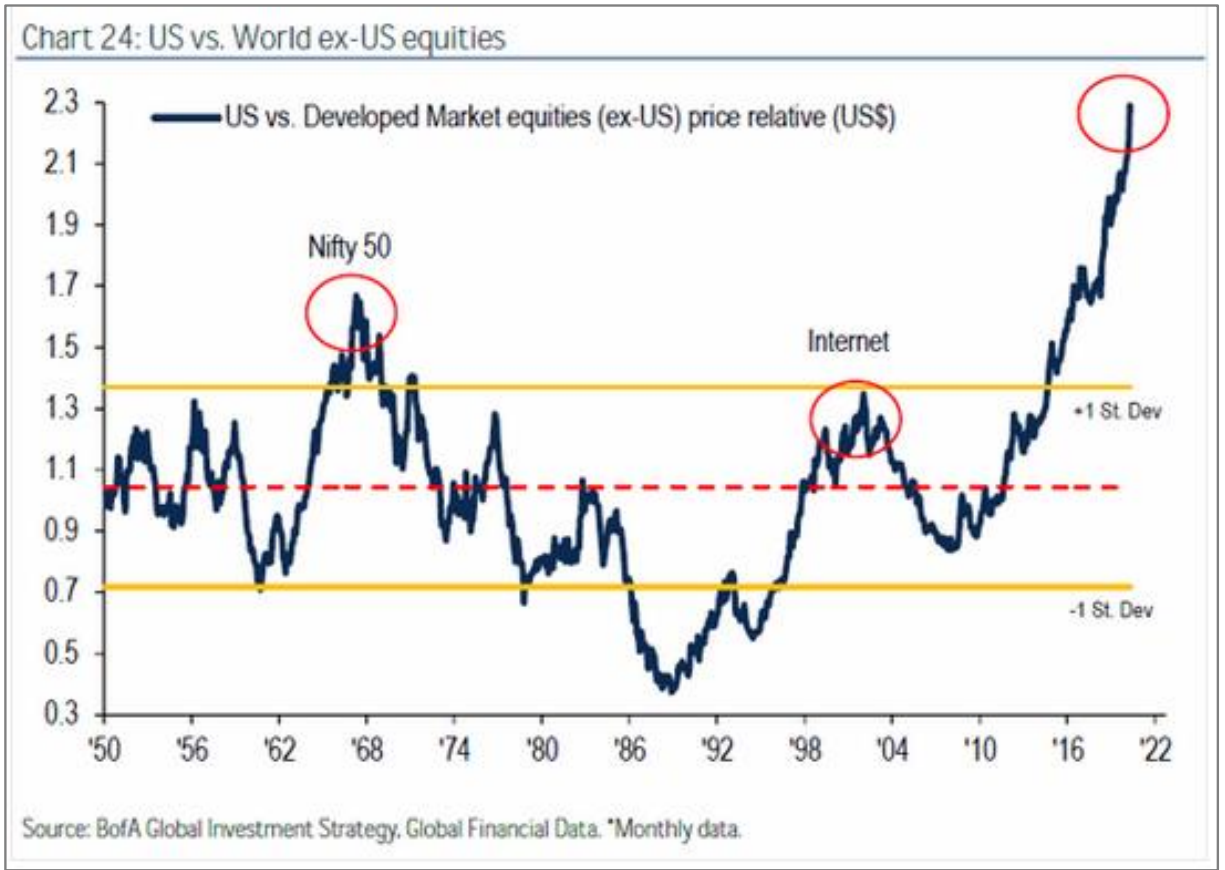
The price of what is known is sky high from a historical standpoint. In the S&P 500, the popular tech stocks have gone to the center of the convention area (even though the convention in May is cancelled). Growth is the most expensive relative to value as far back as it can be measured. Merrill Lynch measured it by sentiment recently:

There are some lonely bargains among the unknowns:
- The banks are being given away. They make money from business happening and money moving. We like JPMorgan (JPM), Bank of America (BAC) and Wells Fargo (WFC).
- Travel has been written an unknown death sentence. Flying now is like eating burgers at Jack in the Box after the E. coli debacle! We like American Express (AXP) and Booking Holdings (BKNG).
- Brick and mortar shopping has been given a death sentence by the futurists. We like Simon Property Group (SPG) and Macerich (MAC).
Only the lonely can play.
Warm regards,
William Smead
The information contained in this missive represents Smead Capital Management’s opinions, and should not be construed as personalized or individualized investment advice and are subject to change. Past performance is no guarantee of future results. Bill Smead, CIO, wrote this article. It should not be assumed that investing in any securities mentioned above will or will not be profitable. Portfolio composition is subject to change at any time and references to specific securities, industries and sectors in this letter are not recommendations to purchase or sell any particular security. Current and future portfolio holdings are subject to risk. In preparing this document, SCM has relied upon and assumed, without independent verification, the accuracy and completeness of all information available from public sources. A list of all recommendations made by Smead Capital Management within the past twelve-month period is available upon request.
©2020 Smead Capital Management, Inc. All rights reserved.
This Missive and others are available at www.smeadcap.com.